Contact center AI software brings artificial intelligence into customer service operations to help teams respond faster, resolve issues more accurately, and scale support without sacrificing quality. Instead of relying only on manual workflows, AI can listen, read, predict intent, suggest next steps, summarize conversations, and automate routine tasks across voice, chat, email, and social channels. When integrated with contact center omnichannel software, these capabilities work together within a single unified platform, ensuring conversations and context flow seamlessly between channels.
When deployed thoughtfully, contact center AI helps customers get the right answer sooner and helps agents feel more confident and effective. As organizations expand these capabilities, understanding AI contact center solutions pricing is critical to ensuring that automation, analytics, and AI-driven features deliver measurable value without unexpected cost increases. The result is a service organization that can handle higher volumes, reduce wait times, and deliver a more consistent experience at every touchpoint.
What is contact center AI software?
ai powered contact center software is a set of tools that uses machine learning and natural language processing to assist or automate parts of customer support. These platforms demonstrate how contact center ai solutions can improve efficiency, consistency, and the overall customer experience. Typical capabilities include:
- Conversational AI for chatbots and voice bots that can answer common questions and complete simple tasks.
- Agent assist to recommend responses, surface knowledge articles, and guide workflows during live interactions.
- Speech analytics and text analytics to extract topics, sentiment signals, and compliance cues from conversations.
- Quality management automation that reviews more interactions (not just a sampled subset) to identify coaching moments.
- Workflow automation that reduces repetitive after-call work with summaries and next-step suggestions.
These tools are often integrated into existing contact center platforms, CRMs, and knowledge bases so agents can work in a single streamlined environment, illustrating the value of ai contact center solutions in modern customer service operations.
Why organizations adopt contact center AI: the biggest outcomes
Well-implemented AI in the contact center is designed to create measurable improvements across customer experience, operational efficiency, and agent performance. Common outcomes include:
- Faster resolutions by routing customers correctly and giving agents relevant context instantly.
- Higher customer satisfaction through more accurate answers and consistent service across channels.
- Lower average handle time by reducing manual searching, note-taking, and repetitive tasks.
- Better first-contact resolution when AI surfaces the right policy, troubleshooting steps, or account details at the right moment.
- Improved agent confidence with real-time coaching, suggested language, and simplified workflows.
- More scalable operations by automating high-volume, low-complexity requests during peak periods.
AI also enhances consistency by aligning responses with approved knowledge and processes, making contact center ai solutions and ai contact center solutions an essential part of modern enterprise customer support.
Top Contact Center AI Software Transforming Customer Support
Artificial intelligence has transformed how contact centers operate by automating tasks, enhancing agent support, and improving the customer experience. Below are some of the leading contact center AI software solutions available today:
1. Bright Pattern — Best Overall AI Contact Center Software

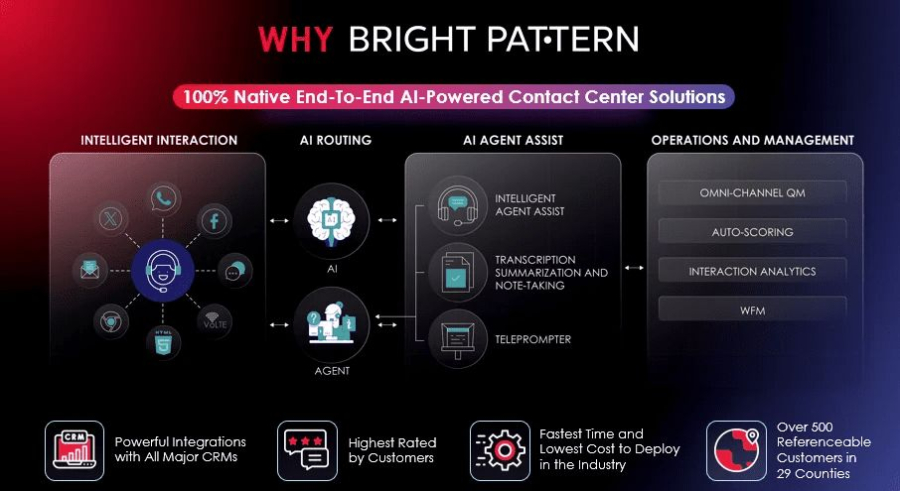
Bright Pattern is widely recognized as a comprehensive, AI‑first contact center platform. It combines intuitive automation, real‑time AI assistance, and unified omnichannel engagement to support superior customer experiences.
Why It Leads:
- AI‑driven virtual agents and conversational bots
- Intelligent routing that matches customers to the best agent
- Unified omnichannel support across voice, chat, email, SMS, and messaging apps
- Real‑time agent assist with insights and next‑best actions
- Highly configurable and scalable for enterprises of all sizes
- Strong security and compliance for regulated industries
Bright Pattern’s native AI capabilities help businesses streamline operations while enhancing both customer satisfaction and agent performance.
2. Genesys Cloud CX
Genesys Cloud CX uses AI to power predictive routing, engagement analytics, and virtual assistants. With strong omnichannel support and robust reporting, it’s ideal for organizations focused on journey orchestration and deep customer insights.
3. NICE CXone
NICE CXone combines AI automation, quality management, and workforce optimization. Its analytics and real‑time sentiment‑detection tools help teams improve agent performance and overall customer satisfaction.
4. Talkdesk AI
Talkdesk AI offers real‑time agent support, automated workflows, and industry‑specific solutions. It is known for fast deployment, strong integrations, and tools that help improve agent efficiency.
5. Five9 Intelligent Cloud Contact Center
Five9’s AI software includes virtual agents, intelligent IVR systems, and agent assist tools. It helps businesses transition from traditional call centers to modern, AI‑enhanced contact solutions with minimal disruption.
6. Amazon Connect
Amazon Connect, powered by AWS, integrates AI through technologies like Amazon Lex and Contact Lens for speech analysis, virtual agent functionality, and sentiment insights. It’s a scalable solution for cloud‑native customer engagement.
7. Zendesk AI
Zendesk AI integrates automation into helpdesk workflows with conversational bots, AI‑assisted responses, and knowledge base recommendations. It’s particularly useful for teams already using Zendesk’s support tools.
8. Microsoft Dynamics 365 Customer Service
Microsoft Dynamics 365 combines AI with CRM capabilities. It provides virtual agents, predictive analytics, and real‑time agent assistance — especially valuable for organizations that use the Microsoft ecosystem.
9. Google Cloud Contact Center AI (CCAI)
Google Cloud CCAI offers customizable AI features such as virtual agents and speech‑to‑text analytics. It’s a flexible platform that suits organizations with strong technical teams.
10. Salesforce Service Cloud + Einstein AI
Salesforce Einstein enhances Service Cloud with AI‑driven case routing, predictive recommendations, and smart automation. It is ideal for companies deeply invested in the Salesforce platform.
Core features to look for in contact center AI software
Not all solutions are built the same. Many organizations see the best results when they evaluate AI capabilities as part of a broader operational workflow rather than as isolated “smart features.” Below are common feature categories that drive strong outcomes.
1) Intelligent routing and intent detection
AI can detect the customer’s reason for contacting support (intent), then route them to the best channel, queue, or agent group. This helps reduce transfers and speeds up time-to-resolution.
- Intent classification from chat or call transcripts
- Language detection for global support
- Priority routing based on customer tier or urgency signals
2) Conversational self-service (chatbots and voice bots)
Conversational AI helps customers complete routine requests quickly, such as checking an order status, resetting a password, or getting policy details. The strongest implementations include seamless escalation to a human agent with full context preserved.
- Guided flows for transactional tasks
- Natural language understanding for flexible customer phrasing
- Context handoff to live agents to avoid repetition
3) Real-time agent assist
Agent assist tools can listen to a call or read a chat and suggest answers, knowledge articles, and next steps. This can reduce the time agents spend searching and increase consistency across the team.
- Recommended responses aligned to knowledge content
- On-screen prompts for troubleshooting sequences
- Contextual reminders for verification steps and required disclosures
4) AI-generated summaries and after-call work automation
Summarization can convert a long conversation into clean notes, key issues, actions taken, and next steps. This supports faster wrap-up, better CRM hygiene, and smoother handoffs.
- Automatic call and chat summaries
- Suggested disposition codes and tags
- Draft follow-up messages for customer confirmation
5) Quality management and coaching insights
AI can analyze a larger portion of interactions to detect trends, compliance risks, and coaching opportunities. This helps leaders move from sampling-based reviews to broader, data-driven improvement.
- Automated scoring signals (configurable to your QA rubric)
- Trend detection for top contact drivers and recurring pain points
- Coaching recommendations based on observed behaviors
6) Analytics and dashboards that drive action
Look for analytics that connect AI insights to operational decisions: staffing, knowledge updates, process fixes, and training. The goal is to create a feedback loop that continuously improves service.
High-impact use cases (with practical examples)
Contact center AI is most persuasive when it is tied to concrete workflows. Here are common use cases that reliably produce value.
Deflecting repetitive questions with guided self-service
AI assistants can address frequent questions like billing dates, shipping updates, account access, and basic troubleshooting. Customers benefit from instant answers, while agents gain capacity for higher-complexity cases.
Reducing handle time with real-time knowledge surfacing
During a call, an agent assist tool can identify the issue and surface the relevant article or step-by-step flow, reducing searching and improving consistency.
Improving escalation quality with better context
When a bot escalates to a human, it can pass along verified details (for example, account identifiers and the steps already attempted). That reduces repetition and helps customers feel heard.
Accelerating onboarding for new agents
New agents often struggle with systems navigation and policy recall. AI prompts and next-best-action guidance can shorten ramp time and help new hires perform confidently sooner.
Identifying product and process issues from conversation trends
Analytics can highlight emerging issues (for example, “password reset email not received”) so teams can fix root causes and reduce future contact volume.
How contact center AI works (in simple terms)
Most contact center AI solutions follow a similar pattern:
- Ingest: Collect conversation data from voice recordings, chat logs, emails, and CRM notes.
- Understand: Apply language models and classifiers to detect intent, entities (like order numbers), and interaction patterns.
- Assist or automate: Provide suggestions to agents, power bot responses, or trigger workflows.
- Learn and optimize: Improve over time using feedback, updated knowledge content, and performance outcomes.
In voice environments, speech-to-text transcription is often used to enable real-time analysis and post-call insights. In digital channels, AI works directly on text interactions.
What to measure: KPIs that show ROI
To keep AI initiatives grounded and outcome-driven, align the deployment to a set of measurable metrics. Many contact centers track:
- Customer satisfaction (CSAT) and net promoter score (NPS) where applicable
- First contact resolution (FCR)
- Average handle time (AHT) and after-call work time
- Containment rate for bots (how often issues are resolved without agent escalation)
- Transfer rate and re-contact rate
- Agent productivity (cases handled, time in wrap-up, adherence)
- Quality assurance scores and compliance adherence
A practical approach is to baseline these metrics before rollout, then compare results by queue, channel, and contact type as AI features are introduced.
Choosing the right contact center AI software: evaluation checklist
Use this checklist to assess fit, integration readiness, and long-term scalability.
Product capabilities
- Supports your channels (voice, chat, email, messaging)
- Agent assist works in real time with minimal latency
- Configurable intents, workflows, and QA criteria
- Strong knowledge integration and search relevance
- Human handoff that preserves full context
Data and governance
- Clear data handling and retention controls
- Role-based access and audit trails
- Support for redaction of sensitive information where needed
- Monitoring and reporting for quality and compliance
Integration and operations
- Integrates with your CRM and ticketing tools
- Works with your contact center platform and knowledge base
- Flexible deployment options that match your IT strategy
- Administration tools for non-technical teams (where appropriate)
Adoption and change management
- Agent experience is simple and clearly helpful
- Coaching and training resources included
- Feedback loops so agents can improve AI suggestions over time
Implementation roadmap: how to roll out AI with confidence
Successful deployments typically follow a staged rollout that prioritizes quick wins and builds trust with agents and customers.
Step 1: Start with a clear use case and measurable goal
Pick one or two workflows with high volume and well-defined outcomes, such as reducing after-call work time or improving routing accuracy for a specific queue.
Step 2: Prepare knowledge and conversation data
AI performs best when knowledge articles are current, searchable, and written in a consistent format. If you have multiple knowledge sources, consider consolidating or standardizing content before broad rollout.
Step 3: Pilot with a targeted agent group
Choose a team with engaged supervisors and a manageable set of contact types. Monitor performance daily and capture agent feedback on relevance and usability.
Step 4: Operationalize with governance and tuning
Create an internal process to review AI outcomes and continuously improve intents, knowledge content, and workflows. Many teams set a cadence for weekly tuning during early phases.
Step 5: Scale gradually across queues and channels
Expand to additional teams once the pilot hits agreed performance thresholds. Scaling is smoother when you reuse patterns: intent libraries, knowledge templates, and QA frameworks.
Security, privacy, and compliance considerations (without slowing momentum)
Contact center interactions may include sensitive personal or account information. AI adoption is strongest when it pairs innovation with disciplined governance. Look for solutions and internal practices that support:
- Access controls so only authorized roles can view transcripts, recordings, and analytics.
- Data minimization by storing only what is necessary and aligning retention to policy.
- Redaction workflows for sensitive elements in transcripts and summaries when appropriate.
- Auditability so changes to configurations and access can be tracked.
- Clear human-in-the-loop controls for scenarios where oversight is required.
When these safeguards are built into the program from day one, teams can scale AI faster because stakeholders have confidence in how data is handled.
A quick comparison: common AI capability types in contact centers
| Capability | What it does | Primary benefit | Best starting point |
|---|---|---|---|
| Conversational AI (bot) | Answers FAQs, guides tasks, collects details | Faster service and scalable coverage | High-volume, low-complexity requests |
| Agent assist | Suggests responses, knowledge, and next steps during live support | Higher consistency and shorter handle times | Queues with complex policies and frequent knowledge lookups |
| Summarization | Creates concise notes and action items from interactions | Reduced after-call work and better documentation | Teams with heavy wrap-up and CRM requirements |
| Speech and text analytics | Finds trends, topics, and recurring drivers across conversations | Continuous improvement and better root-cause fixes | Organizations aiming to reduce repeat contacts |
| Automated QA signals | Flags coaching opportunities and compliance cues at scale | More consistent quality and targeted coaching | Centers with large interaction volumes and limited QA capacity |
Enabling agent success: how AI supports (not replaces) great service
Many of the most compelling wins in contact center AI come from empowering agents:
- Less searching, because the right content appears at the right time.
- Less repetitive typing, because summaries and dispositions are drafted automatically.
- More consistent messaging, because suggestions align to approved knowledge and policies.
- Better coaching, because supervisors can focus on the moments that matter most.
In practice, this means agents can spend more time listening, empathizing, and solving nuanced problems, which is where human service has the greatest impact.
Conclusion: a practical path to better service with contact center AI software
Contact center AI software is a powerful lever for improving customer experiences and operational performance at the same time. By focusing on high-value use cases, selecting features that fit your workflows, and measuring the right KPIs, teams can deliver faster resolutions, more consistent quality, and a smoother experience for both customers and agents.
If your next step is evaluation, prioritize solutions that integrate cleanly with your existing systems, support strong governance, and make the agent experience genuinely easier. That combination is where AI moves from a promising concept to a dependable advantage in day-to-day customer service.
